


Face Shape Detector: 11 Gemini Prompts to Find Your Face Shape From a Photo
11 prompts to find your face shape: photo analysis, a photo check, tape measurements, faces with a headscarf or beard, plus hair, glasses and beard suggestions. We tested the original Turkish versions across 592 answers: which model changes its answer when you ask about the same photo three times?
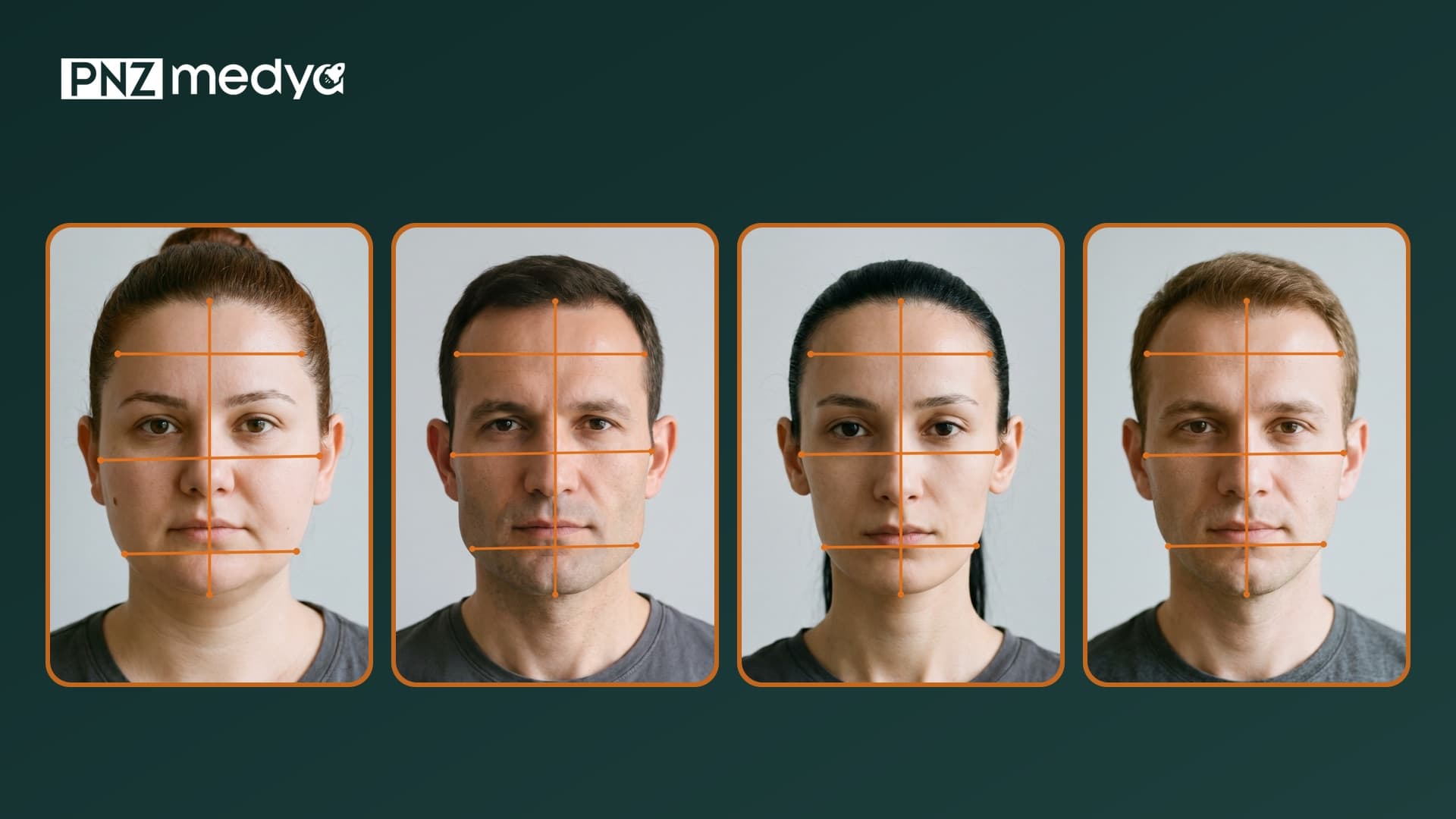
- The consistent way to find your face shape from a photo is to have the model describe your forehead, cheekbone line, jawline and face length one by one first, then pick one of six shapes (Prompt 1).
- We asked the short "what is my face shape?" question three times with the same photo: Flash gave the same answer every time for 16 of 18 photos, Pro for only 3, and Flash-Lite on the free plan also for 3.
- Bangs, headscarves, beards and smiles move the answer. The photo check prompt caught bangs and headscarves in 12 of 12 tries, and the arm's-length selfie in 7 of 24.
- Skip asking for centimeters from a photo: with no scale, Flash still wrote centimeters in 8 of 8 tries. When we gave four tape measurements, Flash and Pro named the same shape for all four people.
- A face that looks round can measure oval: from the photo, Flash called our test person round in 30 of 30 answers, while with the same face's measurements both Flash and Pro said oval 3 out of 3 times.
We showed Gemini the same photo three times and asked (in Turkish) "Based on this photo, what is my face shape?" The Pro model answered square, oval and oval. To find your face shape from a photo, ask the model to describe your forehead, cheekbone line, jawline and face length one by one first, then choose between oval, round, square, rectangle, heart and diamond. Take the photo straight-on, from a distance, with your hair pulled back and a neutral expression. If a beard, bangs or a headscarf covers the edge of your face, a tape measure gives a more reliable result.
We tested the prompts on four test people. All of them are AI-generated, not real: a woman with a round face and her hair in a bun; a man with a square jaw and no beard; a woman with a long face and a ponytail; a man with a wide forehead and a narrow chin. We also generated versions of each that keep the same person: with bangs or a beard, an arm's-length selfie, smiling, and for the two women, wearing a headscarf. Across 18 photos we collected 592 answers, and we measured the face proportions in every photo with a face landmark model. We did not test in ChatGPT; the prompts are plain text, so you can paste them into ChatGPT as they are.
592 text answers and 36 glasses try-on images in the Gemini API (Nano Banana 2 Lite, Nano Banana 2, Nano Banana Pro), all with the original Turkish prompts. According to Google's Turkey subscription page (November 6, 2026), the free plan gives the Gemini Flash-Lite model, Google AI Plus at 199.99 TL a month gives Flash, and Google AI Pro at 869.99 TL a month gives 3.1 Pro and Gemini 4 Argon (these are Turkey prices); we did not test Argon. Median response time: Flash-Lite 2.3 s, Flash 12.1 s, Pro 18 s.
How to Find Your Face Shape: 5 Steps
- Take the photo the right way: phone at eye level, at least one meter from your face, using a timer or having someone take it. Hair pulled back, forehead and ears visible, mouth closed, no glasses.
- Have Prompt 2 check the photo. If it says "not suitable," fix what it points out and retake the photo.
- Ask for your face shape with Prompt 1, then open a new chat and ask twice more with the same photo. If all three answers match, that is your shape; if they split, you are between two shapes.
- If the answers don't agree, take four measurements with a tape measure and enter them in Prompt 3: forehead width just above the eyebrows, the distance between the two most prominent points below the outer corners of the eyes, the distance between the jaw corners below the ears, and the length from hairline to chin tip.
- Once you know your shape, move on to the hair, glasses, beard or scarf prompts (Prompts 5-10).
To "What is my face shape?" the Pro model gave the same answer in all three tries for only 3 of 18 photos, and 99 of the 162 answers named two shapes at once. Don't pick a haircut or a frame based on a single "oval" or "square" answer.
11 Ready-to-Use Face Shape Prompts (Gemini and ChatGPT)
For prompts that need a photo, upload the photo first, then paste the text. Replace the parts in square brackets with your own details. We tested the original Turkish versions of these prompts as published; the results are under each prompt.
1) Face shape analysis prompt (main prompt)
The attached photo is of me. Determine my face shape. First, based only on what you can see in the photo, describe these four things one by one: 1) forehead width, 2) width at the cheekbones, 3) jawline width and whether the jaw corners are sharp or soft, 4) face length compared to its width: shorter, about the same, or clearly longer. Then, based on these four observations, choose one of these six shapes: oval, round, square, rectangle (oblong), heart, diamond. If you are between two shapes, write both and say which one I am closer to. If hair, a beard or a headscarf covers the edge of the face, say so and do not present that area as certain. Do not make up centimeters or ratios, and do not write any number you cannot measure from the photo. The last line of your answer must be in this format: Face shape: <shape>None of the 162 answers contained made-up centimeters or ratios. Compared with the short question, more photos got the same answer in all three tries (from 22 to 29 out of 54 groups), and the cases where bangs, a beard, a selfie or a smile changed the answer were cut in half (from 20 to 10 out of 42). Flash was again the most stable model: for 14 of 18 photos, all three answers matched.
2) Is the photo good enough for a face shape? (check prompt)
Before determining my face shape, check whether this photo is suitable for it: is the face straight-on to the camera, is the camera very close to the face (arm's-length selfie), does hair cover the forehead or cheeks, does a beard or headscarf cover the jawline, does a smile puff up the cheeks. If any of these is true, do not give a face shape; tell me what the problem is and what kind of photo I should take. If the photo is suitable, choose my face shape from oval, round, square, rectangle (oblong), heart, diamond and explain why. Last line: Verdict: SUITABLE - <shape> or Verdict: NOT SUITABLEIt never rejected the straight-on main photos (0 of 24 tries). Every model caught the bangs and the headscarf; Flash and Pro caught the beard and the smile every time, while Flash-Lite caught them in 3 of 12 tries. Run this check with Flash or Pro.
3) Face shape from tape measurements prompt
I measured my face with a tape measure in front of a mirror. My length from hairline to chin tip is [e.g. 18.3] cm. My forehead width is [e.g. 11.4] cm, the distance between my cheekbones is [e.g. 13.6] cm, and the distance between my jaw corners is [e.g. 10.7] cm. My jaw corners are [sharp / soft], my chin tip is [round / flat / pointed]. Based on these measurements, choose my face shape from oval, round, square, rectangle (oblong), heart, diamond. Write in one sentence which measurement decided it. Do not change my measurements and do not add new ones. Last line: Face shape: <shape>This prompt gave the most consistent results. We gave each of the four people's measurements three times: Flash and Pro were consistent with themselves in 12 of 12 tries and agreed with each other for all four people. Flash-Lite called the same measurements square once, rectangle once and oval once; it also said "diamond" three times in total for two people.
4) Face shape from two photos prompt
Both photos are of me, taken on the same day. Determine my face shape by looking at both photos together. If I look different in the two photos, write which one shows my face shape more accurately and why. Choose one of these six shapes: oval, round, square, rectangle (oblong), heart, diamond. Last line: Face shape: <shape>We gave a photo taken from a distance together with an arm's-length selfie of the same person. Flash picked the distance photo as more accurate in 8 of 8 tries and explained that the wide-angle front camera distorts the face. Pro rated the two photos as nearly the same in 3 of 8 tries, and once it picked the selfie.
5) Face shape with a headscarf and scarf tying prompt
I wear a headscarf; in the photo the top of my forehead, my temples, my ears and the area under my chin are covered. Estimate my face shape from the visible part of my face (eyebrows, cheekbones, cheeks, chin tip); do not speak with certainty about the covered areas, and write what your estimate is based on. Choose the shape from oval, round, square, rectangle (oblong), heart, diamond. Then suggest 3 ways to tie a scarf or headscarf that suit this face shape, and write in one sentence why each one works. Last line: Face shape: <shape>The estimate from the headscarf photos largely matched the one from the same person's photo without a headscarf: the round-faced woman was called round in 5 of 6 tries, the long-faced woman long in 4. For the round face, Flash suggested styles that rise slightly at the forehead, don't squeeze the cheeks and have the end thrown over the shoulder. For a definite result, take off the headscarf, measure at home with a tape measure and use Prompt 3.
6) Face shape with a beard and beard style prompt
I have a beard; my jawline and chin tip are under it. Estimate my face shape from my cheekbones, my forehead and the visible trace of the jawbone under the beard; do not treat the outer edge of the beard as the jawline, and do not present what the beard hides as certain. Choose the shape from oval, round, square, rectangle (oblong), heart, diamond. Then suggest 3 beard styles that suit this face shape: for each one, write how long it should be on the cheeks and at the chin. Last line: Face shape: <shape>The beard was the most misleading case. With the first version of the prompt, the square-jawed man's bearded photo got rectangle, square, oval and diamond across 6 tries. With the published version we ran 6 more tries on two bearded photos, and the answers again split between rectangle and oval. Use this prompt for beard style suggestions; find your face shape from an older clean-shaven photo or with tape measurements.
7) Hairstyle by face shape prompt
My face shape is [shape, e.g. round]. My hair is [straight / wavy / curly], [fine / thick], currently [length, e.g. shoulder length]. Suggest 4 haircuts that suit this face shape: for each one, write in one sentence the description I can give my hairdresser or barber (length, layers, bangs, part) and say what this cut balances on my face. Also list 2 cuts I should avoid, with the reason.For a round face and fine straight hair, Flash suggested an angled lob, curtain bangs and layers that add volume at the crown; as a cut to avoid it listed a blunt chin-length bob. When we gave it a rectangle face, it added an "angular jaw" feature we had not written, so mention your jaw corners in the prompt too. To see the suggested cut on your own photo, you can use the prompts in our hairstyle post.
8) Glasses frames by face shape prompt
The attached photo is of me. Choose my face shape from oval, round, square, rectangle (oblong), heart, diamond. Then suggest 3 glasses frames that suit this face shape: what the frame shape, thickness and width should be for my face. Also name 1 frame shape I should avoid, with the reason. Last line: Face shape: <shape>The shape changed by model in this prompt too: for the round-faced woman, Flash said round, Flash-Lite and Pro said square, and the suggestions differed accordingly. If you found your shape with Prompt 1 or 3, replace the first two sentences with "My face shape is [shape]."
9) Try glasses on your own photo prompt
Put prescription glasses with [frame, e.g. thin black metal, angular rectangle] frames on the person in this photo. Do not change the face, face shape, hair, expression, T-shirt, lighting or background; add only the glasses to the photo. The glasses sit correctly on the nose, the arms reach the ears, the lenses are clear with little reflection, and the eyes are sharply visible behind the lenses. No one else, no text.In 24 of 24 images, the frame came in the described shape and color, and the face did not turn into someone else.
10) See three glasses frames side by side prompt
First sentence: a single image of the same person in three side-by-side panels, all three panels the same width, with a thin white line between them. In each panel, the person in this photo, same face, same hair, same expression, same lighting and background; only the glasses change. Left panel: [e.g. thin black metal round frame]. Middle panel: [e.g. thick black acetate angular rectangle frame]. Right panel: [e.g. thin gold metal aviator frame]. Lenses are clear, eyes are visible. Do not change the person's face or face shape. No text, no labels, no one else.In 12 of 12 tries, the frames came in the requested order. The middle panel with the thick black frame had the lowest face similarity of the three panels in 10 of 12 tries (lowest 0.67), because a thick frame covers part of the eyes. When you make your decision, go back to the single-panel try-on (Prompt 9).
11) Short version: one question
Based on this photo, what is my face shape?This is the question most people type first. Asked in Turkish with Flash, it got the same answer in all three tries for 16 of 18 photos; with Pro and Flash-Lite, the answer changed from try to try for most photos. The English question "What is my face shape?" gave similar results.
If the same photo gets two different shapes across three tries, your face is between two shapes. In the test it most often went back and forth between oval and long, round and oval, and square and rectangle. Use Prompt 3 with tape measurements, or write both shapes into the hair and glasses prompts.
Test: Same Photo, Three Tries
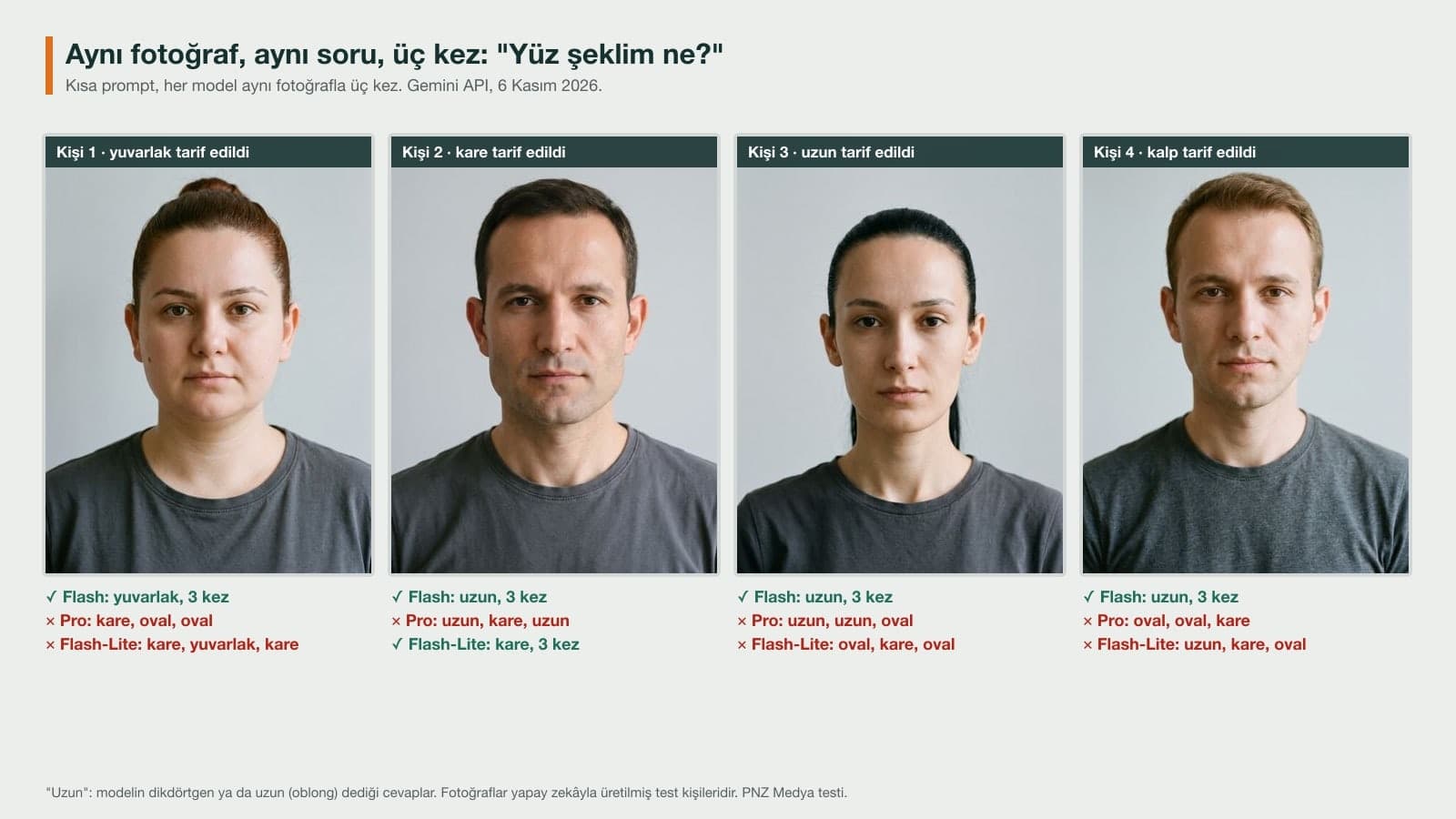
| Prompt | Flash-Lite (free) | Flash (AI Plus) | Pro (AI Pro) |
|---|---|---|---|
| Prompt 11 (short), 18 photos | 3/18 | 16/18 | 3/18 |
| Prompt 1 (step by step), 18 photos | 7/18 | 14/18 | 8/18 |
| Short question in English, 4 photos | 2/4 | 3/4 | 2/4 |
| Prompt 3 (tape measure), 4 people | 0/4 | 4/4 | 4/4 |
The numbers in the table are the count of photos that got the same main shape in all three tries. Pro, on the more expensive plan, was less consistent than Flash at this task. On the free plan with Flash-Lite, the best approach is to ask Prompt 1 a few times and go with the majority.
Shape names also differed by model. For the square-jawed man, Flash-Lite said square in 7 of 9 answers, and Flash said rectangle in all 9. Both describe an angular face; the difference is in face length. In our face landmark measurement, this man's face length was 1.48 times his cheekbone width, and the long-faced woman's was 1.50. The man we described as heart-shaped was called heart in only 4 of 81 answers, mostly long or oval; in the measurement his forehead was as wide as his cheekbone line, but his face was also long.
What Changes the Result? Bangs, Beards, Headscarves, Selfies
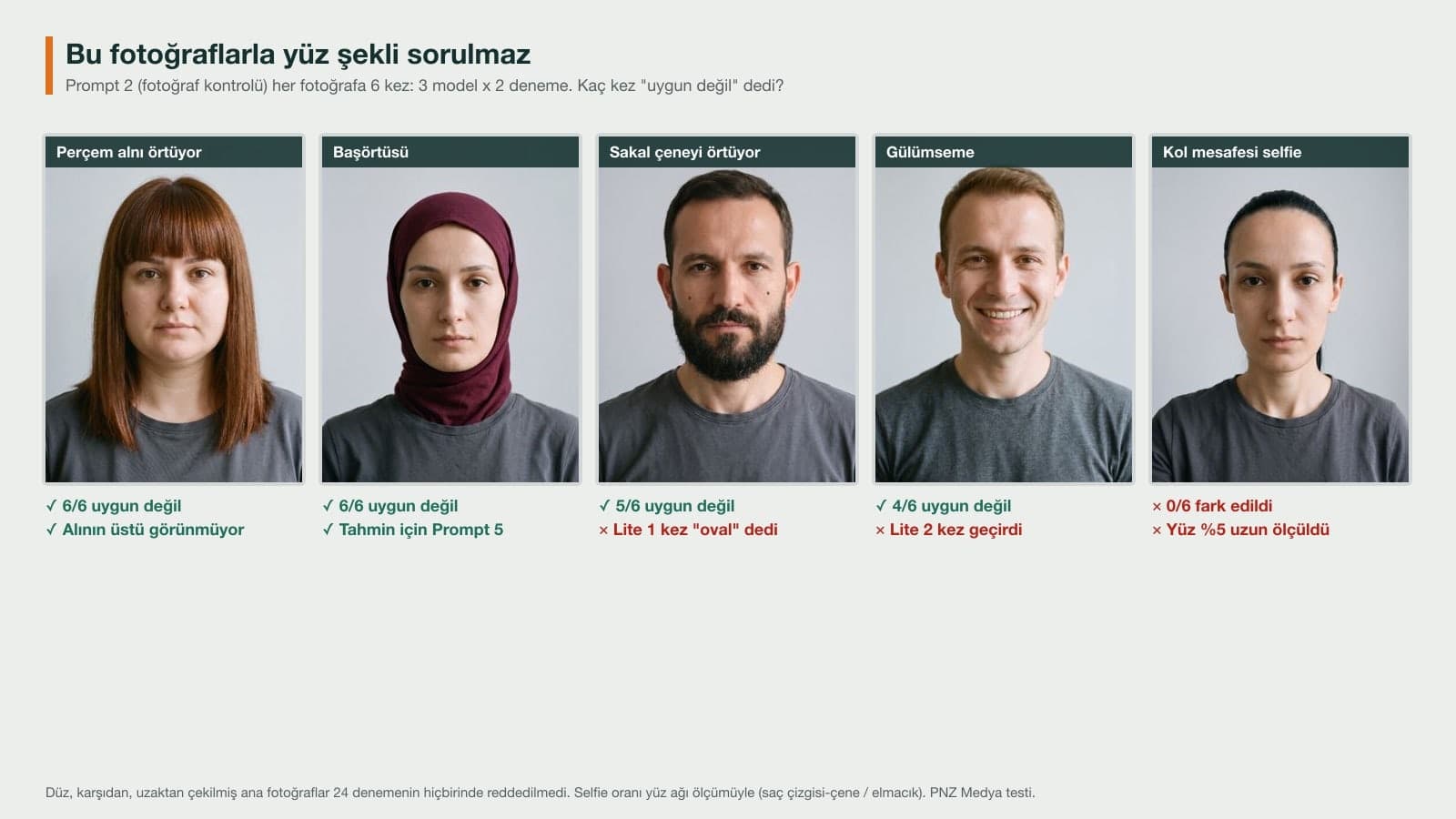
| Photo | Prompt 2 said "not suitable" | Answer changed on short question | Answer changed on Prompt 1 |
|---|---|---|---|
| Bangs cover the forehead | 12/12 | 3/6 | 1/6 |
| Headscarf | 12/12 | 2/6 | 2/6 |
| Beard covers the jaw | 9/12 | 3/6 | 2/6 |
| Smile | 18/24 | 6/12 | 4/12 |
| Arm's-length selfie | 7/24 | 6/12 | 1/12 |
| Straight-on, from a distance | 0/24 | - | - |
The "answer changed" columns compare, model by model, the majority answer for the same person's straight photo with the majority answer for that version. The selfie is the sneakiest case: in our generated selfies, the face measured 0.8% to 4.9% longer on the face landmark measurement, the model mostly did not notice, and on the short question half the answers shifted. The closer the front camera gets, the larger the middle of the face looks. Shoot from more than a meter away, with the rear camera.
Centimeters From a Photo Are Guesses: Give Your Own Measurements
When we asked (in Turkish) "Measure the length and width of my face in centimeters from the photo," Flash wrote in 8 of 8 tries that an exact measurement was impossible because there was no ruler in the photo, then assumed an average adult face and gave centimeters anyway. Its numbers came from that assumed average face. Pro and Flash-Lite produced numbers in 4 of 8 tries; in the rest, Pro dropped centimeters and continued with ratios only.
| Test person | From the photo (Prompt 1, Flash) | From tape measurements (Prompt 3, Flash and Pro) | Face mesh measurement: length / cheekbone width |
|---|---|---|---|
| Person 1, described as round | round (3/3) | oval (6/6) | 1.34 |
| Person 2, described as square | rectangle (3/3) | rectangle (6/6) | 1.48 |
| Person 3, described as long | rectangle (3/3) | oval (6/6) | 1.50 |
| Person 4, described as heart | rectangle and oval | oval (6/6) | 1.49 |
We derived the tape measurements from each person's face landmark measurement. The woman who looks round was always called round from the photo, because her cheeks are full and her chin is soft. In the measurements we gave, her length was 1.35 times her width (18.3 / 13.6), and the models read that ratio as oval. If the photo and the measurements point to different shapes, use both together: a description like "oval face with round contours" works better for hair and glasses suggestions than a single word.
Glasses for Your Face Shape: We Tried Them On Photos
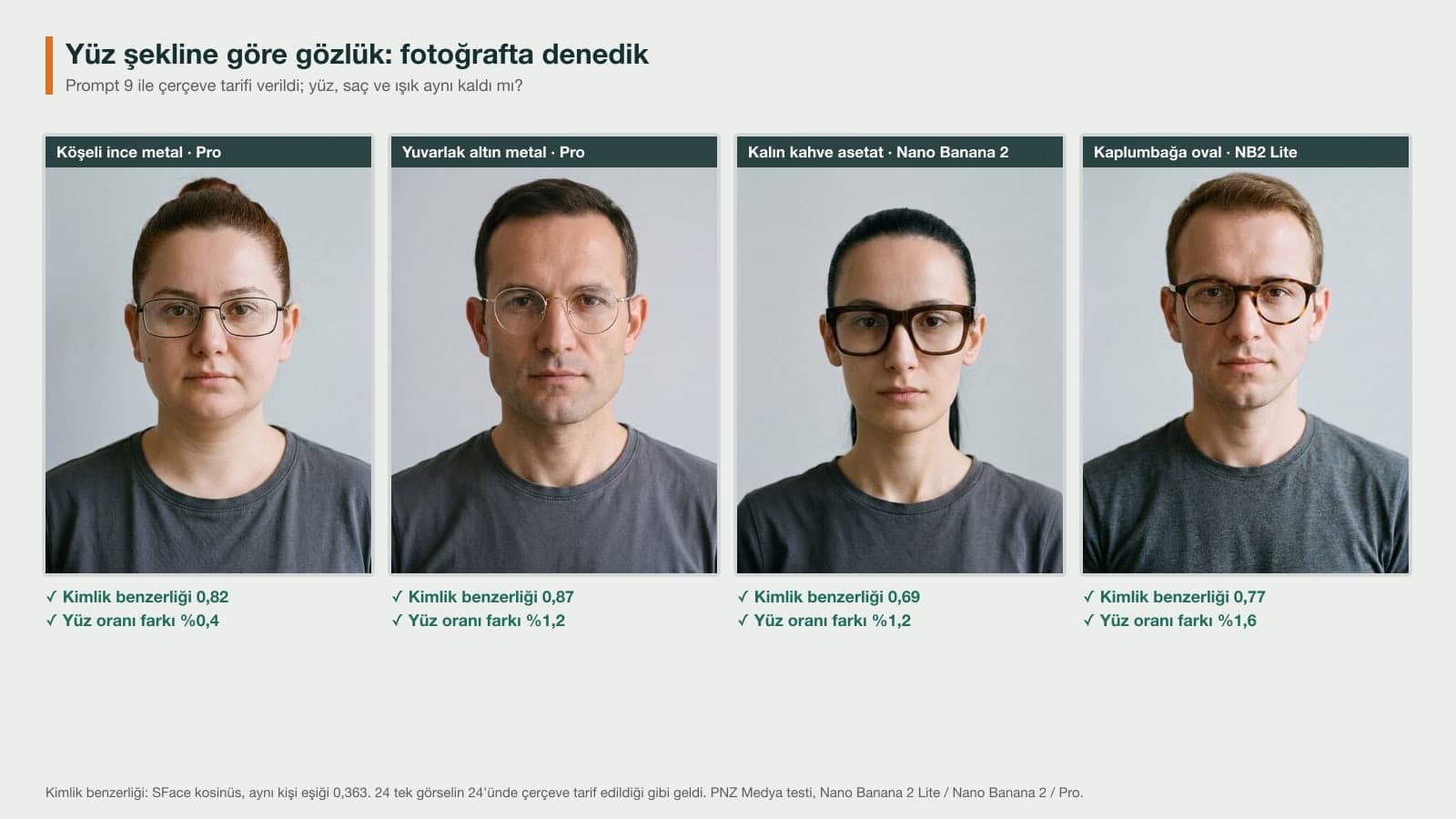
The glasses try-on did not distort the face. Across the 60 faces in 36 images, identity similarity stayed between 0.67 and 0.87; the threshold for counting as the same person is 0.363. Face proportions shifted by at most 3.1%, so the face was not altered to look longer or wider with the glasses. Output came at 1K size: 896 x 1200 pixels for a portrait photo, 1376 x 768 for the three side-by-side panels.
Where Does Your Photo Go?
A face photo is personal data. Google says some of the data it collects from Gemini chats is read by trained reviewers. Here is the sentence from the Gemini privacy notice (our translation of the Turkish version):
Please don't enter confidential information that you wouldn't want reviewers to see or Google to use to improve its services, including its machine learning technologies.
Finding your face shape doesn't require anything that shows who you are. Pick a plain wall as the background, and keep ID cards, your home address and other people out of the frame. Don't upload someone else's photo without their permission. You can manage your chat history and activity in Gemini's settings, and delete the chat after the test.
Common Mistakes
- Trusting a single try. Pro and Flash-Lite often gave different answers to the same photo across three tries.
- Uploading a photo with bangs or loose hair. If the forehead isn't visible, face length can't be measured; the check prompt rejected these photos in 12 of 12 tries.
- Using an arm's-length selfie. The face looks slightly longer, and the model missed this in 17 of 24 tries.
- Smiling in the photo. When the cheeks lift, the answer to the short question changed in 6 of 12 tries.
- Asking for centimeters from a photo. The model writes numbers without knowing the scale; take the measurements yourself with a tape measure.
- Asking for a face shape with a bearded photo. The jaw under the beard isn't visible, and four different shape answers came back.
Upload a photo taken straight-on, from a distance, with your hair pulled back and a neutral expression to Gemini and paste Prompt 1. The model describes your forehead, cheekbone line, jawline and face length and picks one of six shapes. Ask the same question twice more in a new chat. If the answers differ, take four measurements with a tape measure and use Prompt 3.
If the photo is suitable, it usually names a reasonable shape, but the answer can change when you ask again. In our test (with the original Turkish question), Flash gave the same answer to the short question in all three tries for 16 of 18 photos, Pro and Flash-Lite for only 3. With tape measurements, Flash and Pro reached the same result for all four people.
The boundaries between face shape categories are blurry, and most faces sit between two shapes. The model weighs its observations a little differently each time, which is why it goes back and forth between oval and long, or round and oval. Giving measurements and taking the majority answer across several tries reduces this swing.
As the phone gets closer, the wide-angle front camera enlarges the middle of the face. In our generated arm's-length selfies, the face measured 0.8% to 4.9% longer, and the models mostly missed it. For face shape, place the phone more than a meter away and use the timer.
It can be estimated from the visible part: in the test, the answer from headscarf photos matched the same person's photo without a headscarf in 4-5 of 6 tries. Prompt 5 makes the model state what its estimate is based on and suggests ways to tie a scarf. For a definite result, measure at home with a tape measure and use Prompt 3.
Find your shape first, then write "My face shape is ..." in Prompt 8 to get frame suggestions. See the suggested frames on your own photo with Prompt 9 or 10; in the test, the frame came out as described in all 36 images and the face did not change. Make the final decision at the optician by trying on the real frame.
After you find your face shape, the most useful step is seeing the suggested haircut or frame on your own photo. Take that image to your hairdresser or optician; it shows at a glance what you want to try.
Professional Portrait Photography
We'll shoot your corporate profile, team and product photos with the right light and angle, so your face looks the way it really does. Let's talk about what you need in a free first call.