


How to Turn a Photo Into a 3D Figurine: 10 Tested Gemini Prompts (2026)
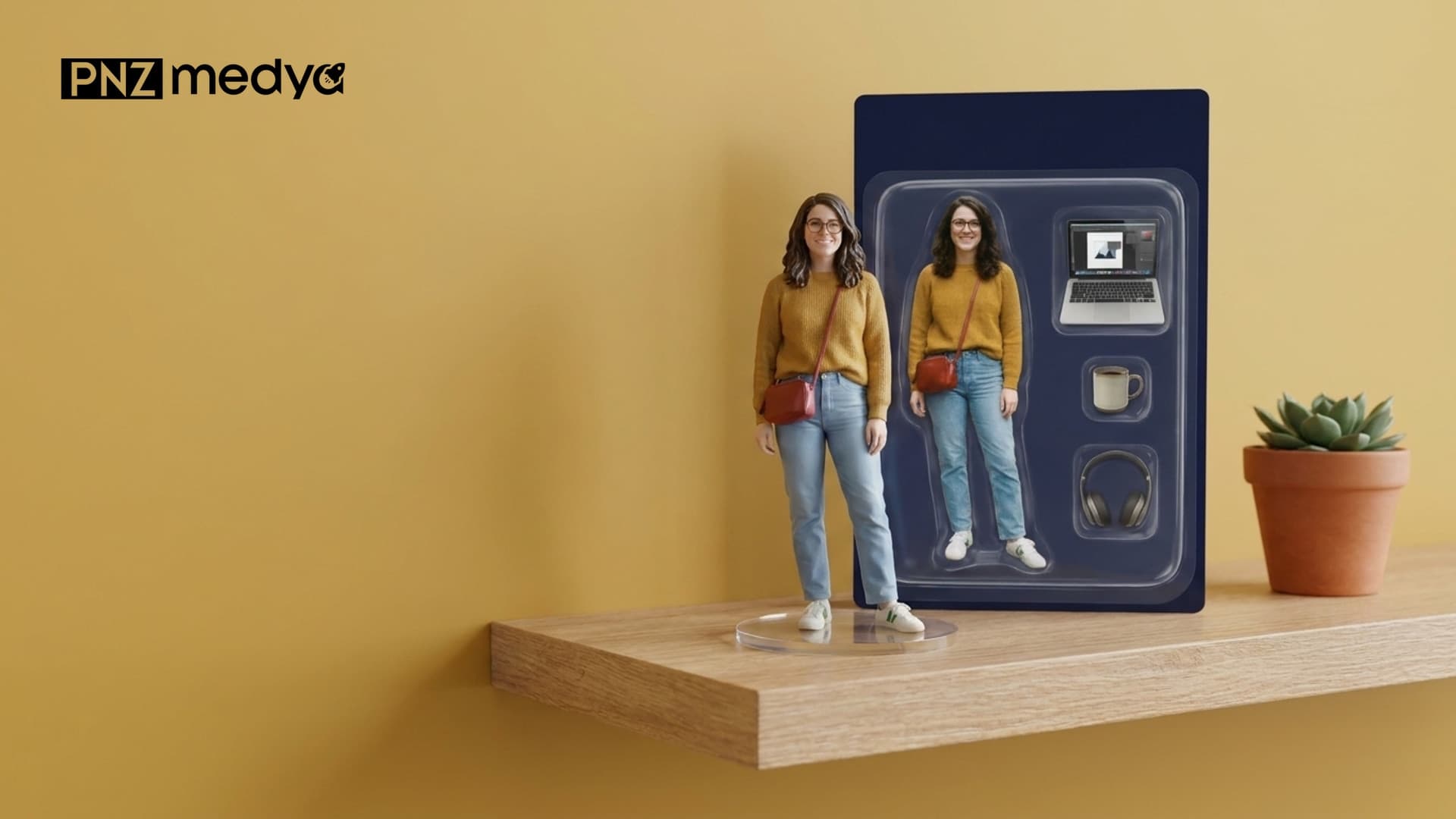
10 prompts tested in Gemini for 3D figurines: a collectible figure on a desk, a boxed action figure, a minifigure, a big-head figure, a pet and a four-angle sheet for 3D printing. Across 134 requests, the short prompt wrote an invented name in 8 of 20 tries; our box prompt gave the right text and exactly 3 accessories in 9 of 9.
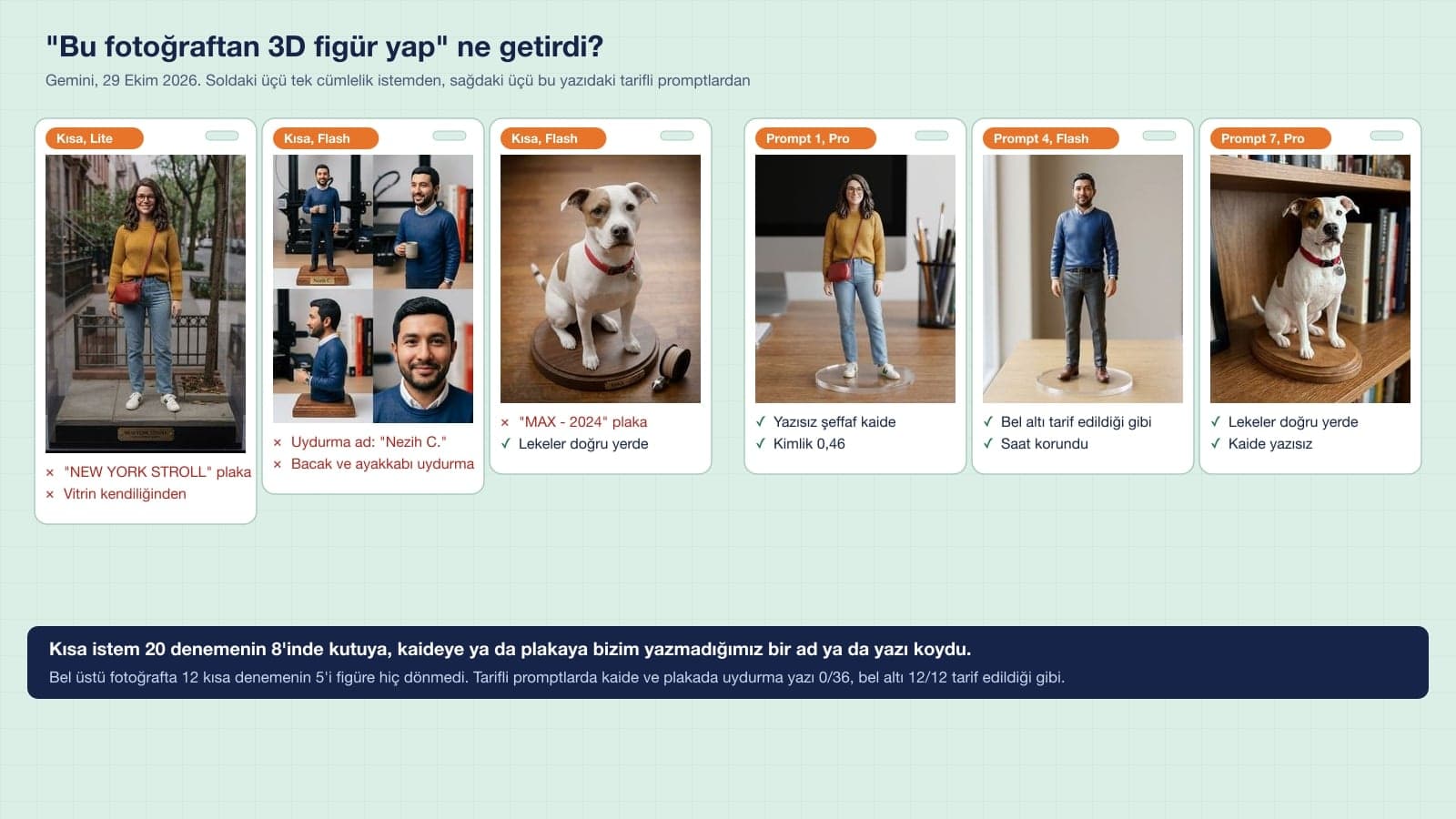
- A one-line prompt like "Make a 3D figurine from this photo" (tested in Turkish) put a name we never wrote on the base, box or plaque in 8 of 20 tries: "Nezih C.", "MAX - 2024", "The Good Boy".
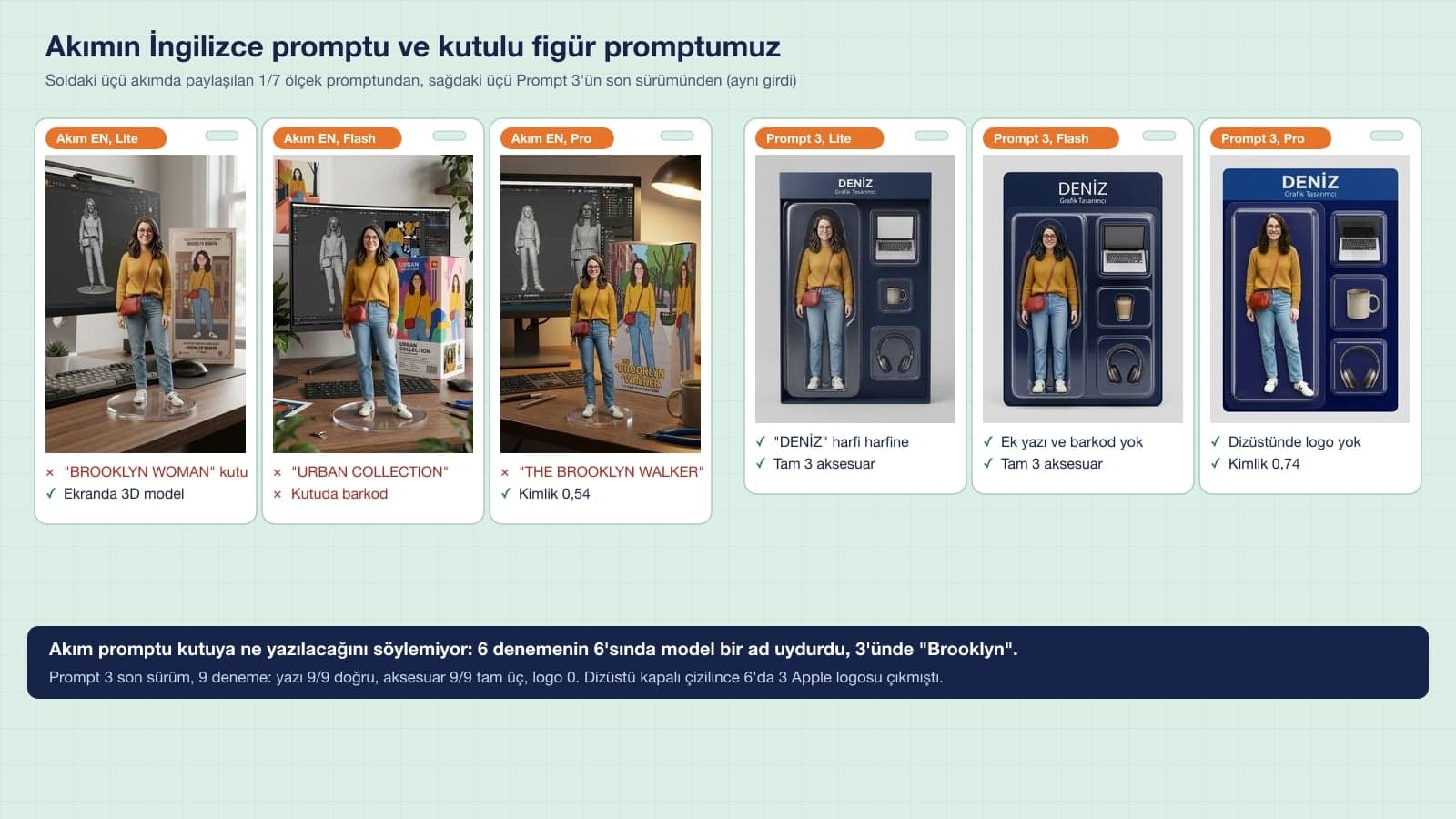
- The English 1/7 scale prompt shared in the trend built the scene in 6 of 6 tries, but invented a series name on the box every time; 3 of them mentioned "Brooklyn".
- For the boxed action figure, our final version (box text in quotes, accessories counted slot by slot) gave the right text and exactly 3 accessories in 9 of 9 tries.
- If the legs aren't in the photo, name the trousers and shoes yourself: the detailed prompt got them right in 12 of 12 tries, while in 12 tries with the waist-up photo the short prompt didn't turn it into a figurine at all 5 times.
- Gemini gives you an image file, not the model file a 3D printer needs; if you want it printed, take a four-angle sheet (Prompt 10) to a 3D modeler.
The one-line prompt "Make a 3D figurine from this photo" put a name we never wrote on the figurine's base or box in 8 of 20 tries: a "Nezih C." plaque for a waist-up photo of a man, "MAX - 2024" for a dog, "NEW YORK STROLL" for a woman photographed on the street. On the waist-up photo, the same prompt also picked the legs and shoes by itself. To turn a photo into a figurine, you have to spell out the base, the box text and any clothing the photo doesn't show, one by one.
We ran the tests on October 29, 2026 in the Gemini API with three image models: Nano Banana 2 Lite (Flash-Lite in the app), Nano Banana 2 (Flash) and Nano Banana Pro. As input we used three fictional photos we generated with AI: a full-body shot of a woman on the street, a waist-up shot of a bearded man in a cafe, and a dog with a brown patch around one eye. 133 of 134 requests returned an image. For every result we looked at the base and the box and read the text, counted the accessories, and measured face similarity with OpenCV's SFace model. Every prompt was tested in its original Turkish wording; the versions below are our English translations.
How to Turn a Photo Into a 3D Figurine: 5 Steps
- Pick the photo. A full-body, front-facing shot with the shoes visible leaves the least to guesswork. A waist-up photo works too, but then you describe the lower half of the outfit yourself (Prompt 4).
- Open Gemini and upload the photo. If you're uploading two photos for a couple figurine, choose Flash in the model picker; according to Google's help page, the Flash-Lite setting isn't designed for multiple image references.
- Choose a figurine type from the list below: a collectible figurine on a desk, a boxed action figure, a building-toy minifigure, a big-head vinyl figure or a pet statuette.
- Fill in the square brackets. If you want text on the box, write it in quotation marks; if you don't, leave the "no text, logos or barcodes" sentence in the prompt.
- Check the result once: the base, the box and the monitor. If a name or logo showed up somewhere, run the same prompt again in a new chat.
If you mention a box in the prompt without saying what's written on it, Gemini adds a series name, a city name, an age warning or a barcode. The trend prompt, which mentions the box but gives no text for it, did this in 6 of 6 tries. If you want a name, write it in quotes; if you don't, say "no text on the box".
10 Ready-to-Use 3D Figurine Prompts (Copy and Paste)
Each prompt runs as a single message after you upload the photo. We tested the original Turkish versions; these are our English translations. Replace whatever is inside the square brackets to match your photo, and delete the brackets. The prompts have a separate sentence for the base, the box and the text, because in the test the model filled every sentence we cut with a choice of its own.
1) Collectible figurine on a desk prompt
Make a 1/7 scale painted PVC collectible figurine of the person in the photo.
The figurine stands on a real work desk, on a round clear acrylic base; there is no text on the base.
Facial features, hair, [glasses], clothing colors and [bag] match the photo.
The figurine's surface is slightly glossy painted plastic; no pores or fine hair like human skin, it is clearly a figurine.
Behind it are an out-of-focus monitor and a pen holder.
No text, logos or brands anywhere in the image.
Realistic product photo, soft daylight, 4:5 portrait.In 6 of 6 tries the figurine came on a clear base with no text, and none got a box. Flash put an Apple logo on the monitor in the background in one image. Face similarity was above the same-person threshold (0.363) in 5 of 6 images.
2) Quick version: one-line 3D figurine prompt
Make a 3D collectible figurine from this photo; no text, names, logos or barcodes anywhere in the image.The text sentence at the end of the single line cut invented names to 1 in 12 tries (Lite still added an "URBAN EXPLORER" plaque). With the full-body photo, 5 of 6 tries turned into a figurine; with the waist-up photo, only 3 of 6. For a photo where the legs aren't visible, use Prompt 4.
3) Boxed action figure prompt (AI action figure)
Turn the person in the photo into a boxed action figure.
Box: [navy blue] cardboard backing and a clear plastic blister on the front. The figure is inside the blister, on the left side, full body.
On the right side there are three separate slots stacked vertically, with one accessory in each slot: top [an open laptop with the screen visible (no logo on the lid or keyboard)], middle [a single coffee cup], bottom [headphones]. 3 accessories in total.
The top band of the box has only this text: "[ALEX]". Below it, in a smaller font, only: "[Graphic Designer]".
No other text, logos, barcodes, age warnings or brands.
The figure's face, hair, [glasses] and clothing match the photo.
The box stands in front of a plain light gray background and fills almost the entire frame; straight-on front product photo, 3:4 portrait.In the test, this version wrote the Turkish name DENIZ and the Turkish job title for "Graphic Designer" letter for letter in 9 of 9 tries (including the dot on the Turkish capital I and the dotless i), and it put exactly three accessories in all 9. Asking for an open laptop fixed the logo problem: in the previous version the model drew the laptops closed, and 3 of 6 images had an Apple logo on the lid.
4) Full-body figurine from a waist-up photo prompt
Make a 1/7 scale painted PVC collectible figurine of the person in the photo; the figurine is full body and standing.
The photo doesn't show anything below the waist: dress the figurine in [dark gray dress trousers], a [black belt] and [brown leather shoes]. Do not add any other clothing.
Face, [beard], hair, [navy sweater], [white collar] and [the silver watch on the wrist] match the photo.
The figurine is on a round clear acrylic base on a wooden table. No text or logos on the base or anywhere in the image.
Surface is slightly glossy painted plastic, clearly a figurine. Realistic product photo, 4:5 portrait.With the waist-up photo taken in a cafe, 6 of 6 tries came with gray trousers, a black belt and brown shoes, and the watch was in place in all 6. Face similarity ranged from 0.48 to 0.64, comfortably above the threshold.
5) Building-toy style minifigure prompt (LEGO-style figure)
Turn the person in the photo into a plastic minifigure in the style of a building toy.
The head is a cylinder with a small cylindrical stud on top; the hands are C-shaped, the arms and legs are flat plastic parts.
The facial expression uses simple printed lines: eyes, eyebrows, smile; [glasses] are printed too.
Clothing colors match the photo and look printed on the torso; the hair is a separate plastic piece that clips on: [shoulder length, wavy, dark brown].
The skin tone matches the skin of the person in the photo.
The figure stands on a [green] building plate, plain light gray background.
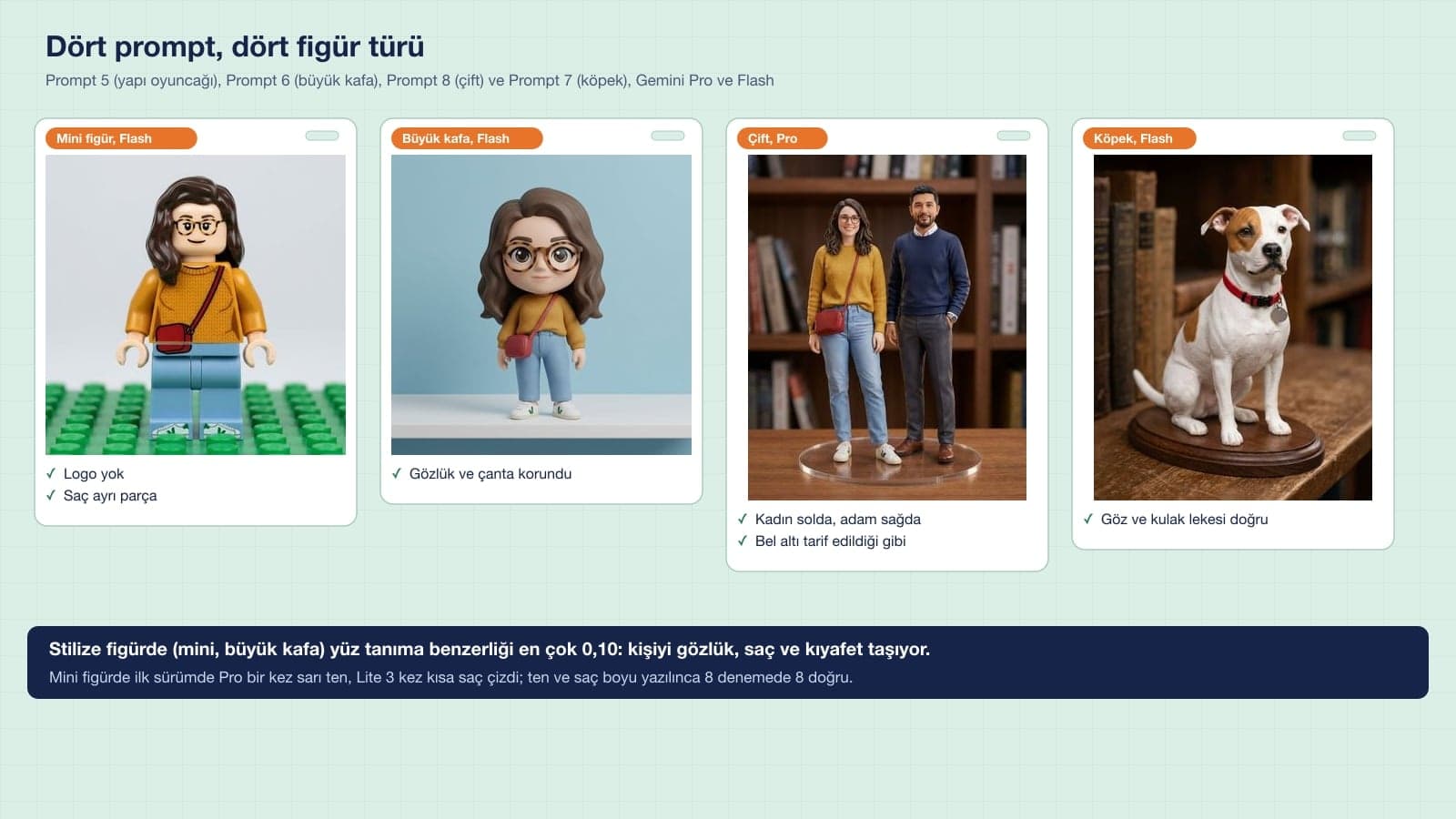
No brand names, logos or text in the image. Close-up product photo, square 1:1.In the first version none of the 6 tries showed a brand name or logo, but Pro drew the classic yellow skin in one image and Lite shortened the shoulder-length hair. Adding the skin tone sentence removed the yellow skin, but Lite still made the hair short in both of its tries. In this final version, where we spell out the hair length and color, the hair came out long and the skin natural in 8 of 8 tries; Lite drew gray hands in just one image.
6) Big-head vinyl figure prompt
Make a cute big-head vinyl figure of the person in the photo.
Proportion: the head is half the combined height of the torso and legs; the eyes are large, but the facial features and [glasses] resemble the person in the photo.
Clothing and [bag] in the same colors as the photo, simplified. Hair color matches the photo.
The figure has a matte vinyl surface and stands on a plain white shelf; plain [pastel blue] background.
No text, logos or box in the image. Product photo, square 1:1.In the first version, 6 of 6 tries had a big head and no text; Pro sat the figure on the edge of the shelf in one image. Adding the word "standing" made all 6 of 6 tries stand. Despite the hair color sentence, Lite lightened dark brown hair to light brown in one image in each of two rounds; if your hair color matters, use Flash or Pro.
7) Pet figurine prompt (cat, dog)
Make a painted resin collectible figurine of the [dog] in the photo.
The fur markings are in the same places as in the photo: [from the viewer's side, left eye and left ear brown, right ear white, one brown patch on the back].
The [red collar] and [round silver tag] are the same; no text on the tag.
[The dog is sitting], the figurine is on an oval wooden base; no text on the base.
The figurine stands on a bookshelf, background out of focus. Surface is painted resin, clearly a figurine.
No text or logos in the image. Realistic product photo, 4:5 portrait.The markings were in the right place in 6 of 6 tries, and no base got a name. With the short prompt ("Make a 3D figurine of my dog", tested in Turkish) the markings were also right, but in 3 of 6 tries the dog got a name like "Buddy" or "MAX - 2024", or a "THE GOOD BOY" plaque. Writing directions "from the viewer's side" keeps left and right from getting mixed up.
8) Couple figurine prompt (with two photos)
Make a 1/7 scale painted PVC collectible figurine of the people in these two photos standing together.
The [woman] from the first photo is on the left from the viewer's side, the [man] from the second photo is on the right; both stand side by side on the same round clear base.
Each person's face, hair, [glasses] and clothing match their own photo.
[The second photo doesn't show anything below the waist: dress the man in dark gray dress trousers and brown leather shoes.]
The figurine stands on a bookshelf, background out of focus. No text or logos on the base or in the image.
Realistic product photo, 4:5 portrait.In 6 of 6 tries the order was right, both people stood on the same base, and the man's lower outfit came out as described. Face similarity was above the threshold for both people in 6 of 6 images. If both photos are full body, delete the bracketed fourth line.
9) Gemini 3D figurine trend prompt, rewritten with fixed box text
Make a 1/7 scale, realistic painted PVC collectible figurine of the person in the photo and show it in a real environment.
The figurine stands on a computer desk, on a round clear acrylic base; no text on the base.
The computer screen shows this figurine's gray model open in a 3D modeling program; no readable text on the screen.
Next to the screen is a cardboard box in the style of a high-quality collectible figure; the front of the box has a two-dimensional, flat-color illustration of the figurine.
The box has only this text on it: "[ALEX]". No other text, series name, city name, barcode or logo.
No brand logos on the monitor, the keyboard or the items on the desk.
Face, hair, [glasses], clothing and [bag] match the photo. Realistic photo, soft daylight, 4:5 portrait.This is the same scene as the trend: a desk, the figurine's 3D model on the screen, a box next to it. The difference is the box text. In 6 of 6 tries the box said only "DENIZ" (the name we used in the test), with no series name or barcode, and the gray model was open on the screen in all 6. Flash wrote "DELL" under the monitor in one image.
10) Four-angle model sheet prompt for 3D printing
Draw a model sheet showing the person in the photo as a 3D figure from four angles.
In a single row, four views from left to right: 1) straight front, 2) straight side (profile), 3) straight back, 4) three-quarter view from the front: the figure turned slightly toward the viewer, face visible.
All four are the same figure, same height, same clothing and colors.
The figure is painted in the colors from the photo (no unpainted plain gray resin).
Background is plain light gray #D9D9D9 all the way to the edges, no shadow, no base.
No text, dimension lines, labels or logos in the image. Landscape 16:9.In the first version we described the fourth view only as "three-quarter view"; in 3 of 6 tries the figure came out three-quarter from the back, with the face hidden. Once we numbered the views and added "face visible", the face showed in 6 of 6. Lite tied the hair up in the back view in one image.
Run the same prompt once more in a new chat, and check that the "no other text, logos or barcodes" sentence is still in the prompt. Logos mostly appear on real products such as closed laptops and monitors: ask for that object open, with the screen visible, or out of focus. If the figurine came out looking like a photo, add the sentence "clearly a figurine, on a base".
3D Figurine Test: What Came Out of 134 Requests?
| Prompt | Tries | Desired result | Problem |
|---|---|---|---|
| Short, in Turkish: "Make a 3D figurine from this photo" (full-body woman) | 8 | 6/8 clearly a figurine | 2 invented texts (a plaque; an age warning and barcode); Pro refused once |
| Short (waist-up man) | 6 | 4/6 figurine | 3 invented names or texts; legs and shoes invented 2 times |
| Short: "Make a 3D figurine of my dog" | 6 | Markings 6/6 correct | 3 invented names ("Buddy", "MAX - 2024", "THE GOOD BOY") |
| Prompt 2, one line, no text | 12 | Invented text 1/12 | Waist-up photo turned into a figurine 3/6 |
| The trend's English prompt | 6 | Scene 6/6 | Invented series name on box 6/6, barcode 1 |
| Prompt 9, trend scene (Turkish original) | 6 | Only "DENIZ" on box 6/6 | "DELL" on monitor 1 |
| Prompt 3, boxed figure (final version) | 9 | Text 9/9, exactly 3 accessories 9/9 | None |
| Prompts 1, 4, 5, 6, 7, 8 (detailed) | 36 | Invented text on base 0/36 | Apple logo on monitor 1, yellow skin 1 |
Two things stand out in the table. First, the model adds text on its own, mostly on boxes and plaques; once the prompt has a sentence about text, this almost disappears. Second, a short prompt leaves even the figurine itself to chance: in 2 of 4 tries Pro drew the woman on the street with no base, like a photo. Pro also refused the same short prompt once, citing PROHIBITED_CONTENT; the same prompt worked in the next three tries. In 95 of the 95 requests where we specified an aspect ratio, the image came in that ratio; when we didn't, the ratio of the uploaded photo was kept.
Gemini 3D Figurine Trend Prompt: Who Writes the Name on the Box?
Create a 1/7 scale commercialised figurine of the characters in the picture, in a realistic style, in a real environment. The figurine is placed on a computer desk. The figurine has a round transparent acrylic base with no text on the base. The content on the computer screen is a 3D modelling process of this figurine. Next to the computer screen is a toy packaging box, designed in a style reminiscent of high-quality collectible figures, printed with original artwork. The packaging features two-dimensional flat illustrations.
The trend spread with Nano Banana in September 2025. According to a TechCrunch report from September 16, 2025, Josh Woodward, Google's vice president for Gemini and Labs, wrote on September 8 that the app had gained 23 million new users since the model launched and that those users had shared more than 500 million images; on September 12 Gemini reached No. 1 on the US App Store. The prompt itself forbids text on the base but has no such sentence for the box. As a result, all 6 of 6 boxes carried names like "THE BROWNSTONE GIRL", "URBAN COLLECTION" and "THE BROOKLYN WALKER". The names seem to come from the photo's background: the street in the input looked like New York brownstones, and 3 boxes mentioned "Brooklyn".
Action Figure Box: Accessory Count and Logos
We tested the boxed figure prompt in three rounds. In the first version the text was right in 6 of 6 tries, but Lite put two cups in one box, and in 3 of 6 the box sat in front of a white background. In the second version, once we wrote the slots as "three slots stacked vertically, one accessory in each", the accessory count held in 6 of 6; the sentence meant to stretch the box to the edges didn't work, and boxes left in front of a background rose to 5 of 6. In the same round, half of the laptops drawn closed had an Apple logo. In the final version we accepted the background as plain light gray and asked for the laptop open and logo-free: no logos in 9 tries, accessories complete, and face similarity above the threshold in 8 of 9.
Figurine Types: 1/7 PVC, Minifigure, Big Head, Resin
| Type | Material written in the prompt | Which photo | Watch out (from the test) |
|---|---|---|---|
| 1/7 collectible figurine | Painted PVC, clear acrylic base | Full body or waist-up (Prompt 4) | Highest face similarity of all types |
| Boxed action figure | Cardboard backing, plastic blister | Full body | Give the box text in quotes |
| Building-toy minifigure | Cylinder head, C hands, plate | Any | Specify skin tone and hair length |
| Big-head vinyl | Matte vinyl, head half the height | Face clearly visible | Lite may lighten the hair color |
| Pet statuette | Painted resin, wooden base | Whole animal visible | Describe markings from the viewer's side |
We measured face similarity with SFace cosine similarity; the accepted same-person threshold is 0.363. For realistic figurines (Prompts 1, 3, 4 and 8), 31 of 33 faces were above the threshold, with a top score of 0.82. For the minifigure and big head, the 12 first-round measurements reached 0.10 at most: the face recognition model treats a stylized face as a different person. In these types the likeness comes from glasses, hairstyle and clothing color, so we named all three in the prompt.
Four-Angle Sheet for a 3D Printed Figurine
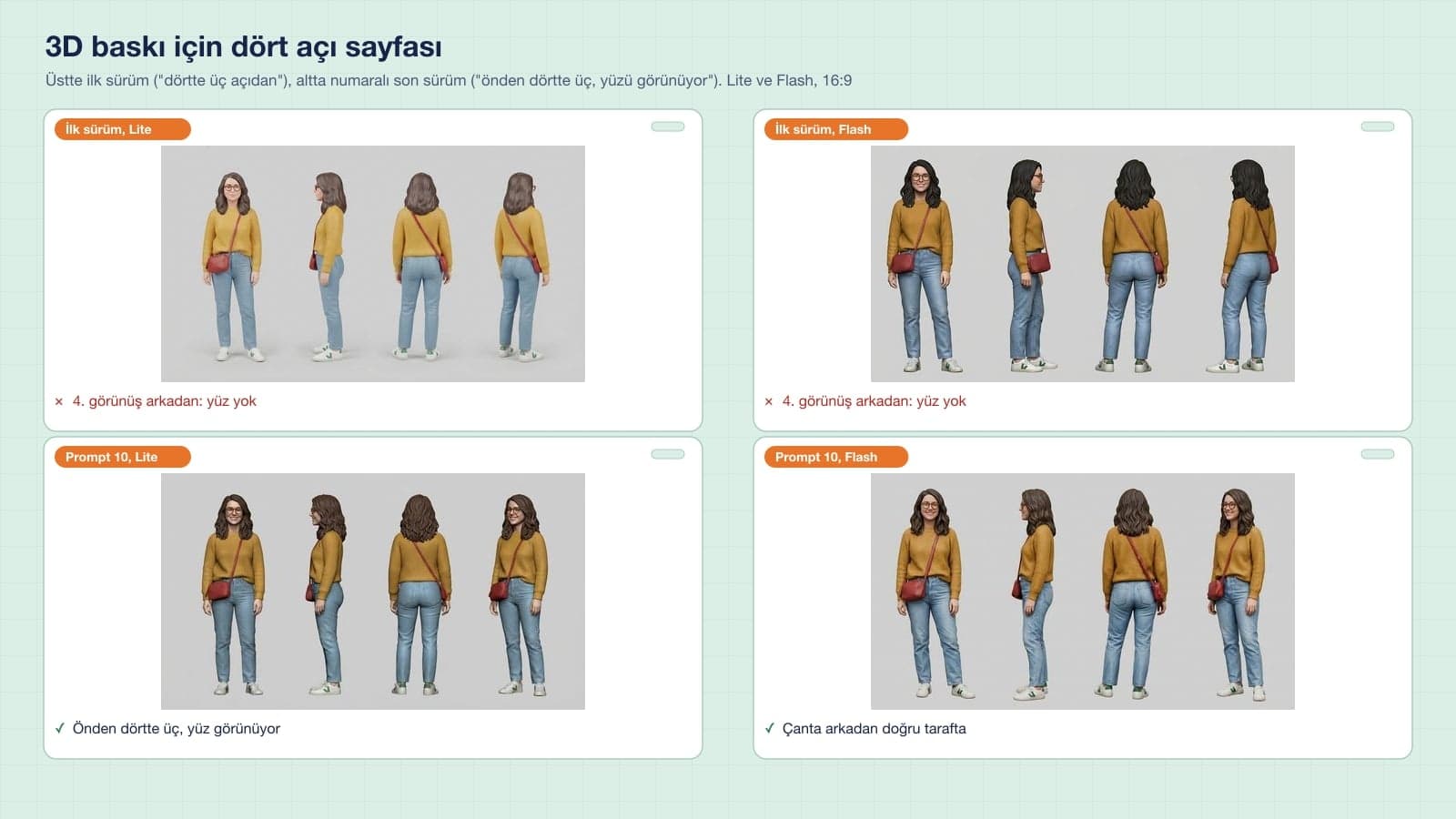
Gemini's image model outputs a JPEG or PNG image; all 133 results in the test were flat image files. A 3D printer needs a model file such as STL. If you really want the figurine printed, the four-angle sheet from Prompt 10 is a reference for a 3D modeler or for a tool that builds a model from images. On a Gemini account without a plan, images download at 1K: a 16:9 sheet is 1376 x 768 pixels, so each view gets a column of about 340 pixels. According to Google's help page, a Google AI plan lets you download at 2K; for a detailed model, 2K is a better reference.
Which Gemini Model? Lite, Flash or Pro
| Model (setting in the app) | Median time | What it did well in the test | Where it had trouble in the test |
|---|---|---|---|
| Nano Banana 2 Lite (Flash-Lite) | 6.2 s | Speed; order right 2/2 on the couple figurine | 4 accessories in the box in the first version; 4 invented plaques with the short prompt; shortened hair on the minifigure |
| Nano Banana 2 (Flash) | 10.1 s | Face similarity 0.48-0.82 on the boxed figure | Invented legs with the short prompt 2/2; logo on the monitor 2 times |
| Nano Banana Pro (Pro plan) | 17.8 s | Face 0.55-0.58 on the full-body figurine from a waist-up photo; box text 3/3 | Photo instead of figurine 2/4 with the short prompt; 1 refusal |
According to Google's help page, on an account without a plan, images are made with Nano Banana 2 Lite when the model picker is on Flash-Lite and with Nano Banana 2 when it's on Flash or Pro; Nano Banana Pro requires a Google AI plan. For figurines we recommend Flash: it's about 4 seconds slower than Lite, but its box text, hair and faces came close to Pro. Leave Lite for quick single-photo tries.
Common 3D Figurine Mistakes
- Asking for a box or plaque without giving its text. The model fills the gap with a series name, a city name or an age warning.
- Asking for a full-body figurine from a waist-up photo without describing the lower outfit. In the test, Flash picked the trousers and shoes itself in both tries.
- Writing a pet's markings as just "right" and "left". Say "from the viewer's side" so it's clear which side you mean.
- Listing accessories in one sentence. Even though we wrote "exactly 3 accessories", Lite put two cups in one box; describing the slots one by one, stacked vertically, fixed it.
- Expecting a print-ready 3D model file from Gemini. The output is an image; for printing, the four-angle sheet is your reference.
Other People's Photos, Kids' Photos and Privacy
The photo you upload for a figurine is personal data for everyone whose face is visible in it: Turkey's data protection law (KVKK, Law No. 6698) defines personal data as "any information relating to an identified or identifiable natural person" (our translation). Get permission before uploading a photo of a friend or your child. According to Google's help page, you must be 18 or older to generate and edit images in Gemini.
Impersonating an individual (living or dead) without explicit disclosure, in order to deceive
Making a figurine of a celebrity often works technically; the line in the policy is presenting the image as if that person really released such a product. Putting a real toy brand's name or logo on the box raises the same problem. That's why every prompt in this post has the "no logos or brands" sentence.
Open Gemini, upload a full-body photo and paste Prompt 1 from this post. The prompt says the base has no text and the image has no logos; in the test, 6 of 6 tries returned a collectible figurine on a text-free base.
Yes. We tested all 10 prompts in their original Turkish wording, and Turkish box text came out right too: the name DENIZ and the Turkish title for "Graphic Designer" appeared letter for letter in 9 of 9 tries.
Give the name in quotation marks and add the sentence "no other text, logos or barcodes" (Prompt 3). If you don't give the text, the model invents a name on its own; the trend's English prompt did this in 6 of 6 tries.
Yes, but you have to describe the lower outfit yourself. When we specified the trousers, belt and shoes in Prompt 4, 6 of 6 tries came out the way we wanted; the short prompt either chose the legs itself or never turned the photo into a figurine at all.
Yes, Prompt 7 is for that. Describe where the markings are from the viewer's side; in the test, the dog's eye and ear markings were in the right place in 6 of 6 tries, and no name was written on the base.
The prompts are plain text, so you can paste them into ChatGPT too. In this round we only measured Gemini's three image models; we won't comment on ChatGPT results without testing them.
If you're going to shoot the figurine's box like a product photo, the rule from the product photography post applies here too: give the label text in quotes, and describe the side that can't be seen. If you'd rather bring people from two separate photos together in a single photo instead of a figurine, see the photo combining prompts.
E-Commerce Sites for Workshops Selling Custom Figurines
If you sell 3D printed figurines, statuettes or personalized gifts, we'll build an e-commerce site where customers upload a photo, pick a scale and a box, and place their order. In a free first meeting we'll plan your product pages and order flow together.